

AC installation and replacement in Dayton & Cincinnati.
Comparing quotes? Ours starts with a load calculation on your house, not a match to the label on the old unit. You get the sizing math, a written price and financing options in one visit, free.
Right-sized, high-efficiency air conditioners installed clean and to code. Honest sizing math, free replacement estimates, and flexible financing.
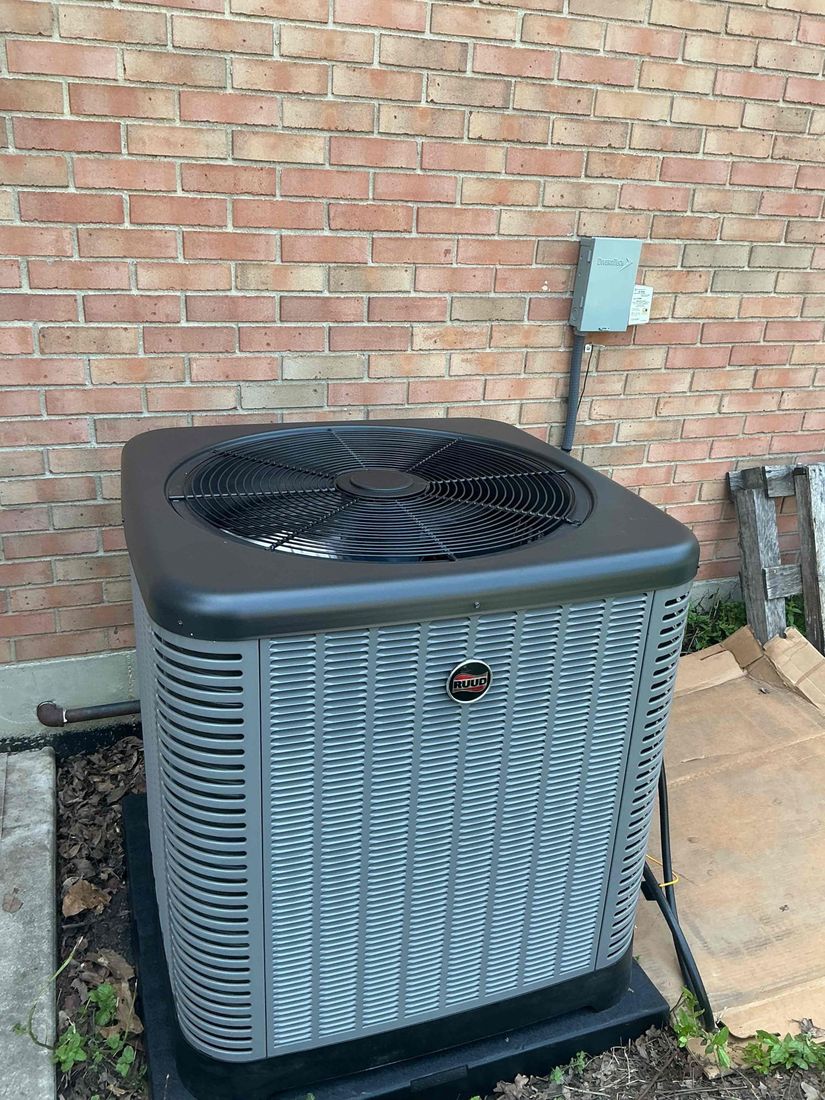
Signs a new AC makes sense.
What does an AC installation include?
The outdoor condenser, the indoor evaporator coil, the line set connection, the electrical whip and disconnect, and the refrigerant charge. Your old equipment and refrigerant leave with the crew. The system gets commissioned and measured before anyone signs off on it. If yours still has years in it, a repair is usually the better money.
What gets checked that most quotes skip
Line set condition, the size of the existing electrical circuit, condensate drainage, and whether the return duct can move the air the new system needs. A larger system on an undersized return is the most common reason a new AC underperforms.
What size air conditioner does my house need?
Size comes from a heat gain calculation on the specific house: square footage, insulation, window area and orientation, ceiling height, and duct condition. Matching the tonnage on the old label repeats whatever mistake was made last time. An oversized system short cycles, and a Dayton summer still feels clammy at the set temperature. Sizing only matters once you have settled the earlier question, which is whether to repair or replace the air conditioner at all.
Why oversizing costs comfort
An oversized air conditioner cools the thermostat fast and shuts off before it has pulled moisture out of the air. The house hits the set temperature and still feels damp. The fix is right-sizing rather than more tonnage.
A visit without surprises.
Single-stage, two-stage, or variable-speed: which one fits?
There are three grades to choose from, and where they differ most is how well they pull humidity out of the house in August.
Single-stage, two-stage and variable-speed air conditioners compared.
| Factor | Single-stage | Two-stage | Variable-speed |
|---|---|---|---|
| How it runs | Full capacity or off | High or low capacity | Adjusts continuously across a wide range |
| Temperature swing | Largest swing between cycles | Smaller swing between cycles | Smallest swing, closest to the setpoint |
| Summer humidity | Shorter run times remove less moisture | Longer low-stage runs remove more moisture | Long low-speed runs dehumidify continuously |
| Noise | Loudest at every startup | Quieter while in low stage | Quietest, ramps up rather than starting hard |
| Efficiency | Lowest SEER2 ratings in the line | Middle of the line | Highest SEER2 ratings in the line |
| Upfront cost | Lowest of the three | Middle of the three | Highest of the three |
| Best fit | Like-for-like swap, light use, rental property | Most Dayton and Cincinnati homes | Two-story homes, humidity complaints, long cooling seasons |
How much does a new air conditioner cost in Dayton or Cincinnati?
There is no honest single number, and anyone who gives you one over the phone is guessing at your house. A straight condenser and coil swap on sound ductwork is a different job from one that needs a new line set, a new pad and a circuit run, and the gap between them is wide. What we can do is tell you exactly what moves the figure, so the quote you get makes sense instead of arriving as a surprise.
Sizing and ductwork move the number more than the badge on the equipment does, and both are decided at the survey rather than over the phone.
What moves the price of a new air conditioner.
| What we look at | Which way it moves the price | How you can tell before we arrive |
|---|---|---|
| Size, from a heat gain calculation | Both ways. Matching the tonnage on the old label repeats the last mistake | An oversized unit cools fast and leaves the house clammy |
| Efficiency tier | Up front, down on the summer bill | Worth pricing both when you plan to stay in the house a while |
| Ductwork and return capacity | Up, and it is the most common reason a new system underperforms | A larger system on an undersized return will disappoint you either way |
| Line set, pad and disconnect | Up, when the existing ones cannot be reused | A line set that has carried R-22 usually cannot stay for a new refrigerant |
| R-22 in the old system | Up, because none of it carries over and the whole system is replaced | R-22 has not been produced or imported in the US since 2020 |
| Permit and inspection | A fixed local cost that changes from town to town | We pull it and close it out. Never optional |
How long does a replacement take?
Most are a single day. We usually install within a day or two of the estimate, same week even in the middle of summer. Adding ductwork, a new circuit or a new pad stretches it out. If you are open to it, price a heat pump alongside at the same time.
Can I finance it?
Yes, and a new air conditioner starts as low as $49 a month with approved credit. That is the best-case advertised payment rather than a quote for your house. Three lenders look at the application, GoodLeap, Synchrony and Wright-Patt Credit Union, and they set the rate and the term rather than us. You see the payment options next to the written quote, before anything is ordered. More on the financing page.
How do I book an estimate?
Call (844) 584-7399 or book online. Replacement estimates are free, and one visit covers the load calculation, a written quote and your financing options. Once the new system is in, the X-Plan membership is what keeps it healthy.
What else do homeowners ask before replacing an AC?
Last updated
