

Toilet repair and replacement in Dayton & Cincinnati.
Running fill valve, clogs that keep coming back, water at the base, a bowl that rocks. Most of it is a single visit. Some of it is a ten-minute job you can do yourself, and we will say which is which.
Some of this is a ten-minute fix you can do yourself. We will tell you which.
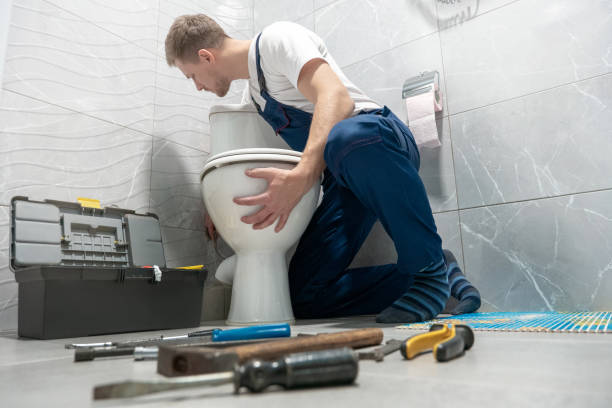
Signs it needs a pro.
Repair, replace, or upgrade.
Why does my toilet keep running?
Most of the time it is the flapper: the rubber seal at the bottom of the tank hardens, stops sealing, and lets water trickle into the bowl until the fill valve kicks back on. A flapper is inexpensive and takes about ten minutes. If a new flapper does not fix it, the fill valve is next.
It is worth doing quickly. A toilet running non-stop can put about 200 gallons a day through your meter, so this is a bill problem more than a noise problem.
Is a running toilet a DIY job or a plumber job?
If replacing the flapper fixes it, it is a DIY job and you should keep the money. Call a plumber when the leak is at the base, when the bowl rocks, when the tank is cracked, or when the flange under the toilet has failed. Those need the toilet pulled.
Cracked porcelain, or a unit older than the 1994 efficiency standard, and you are better off replacing it than buying parts for it.
When a toilet is worth repairing and when it should be replaced.
| What we look at | Repair when | Replace when |
|---|---|---|
| What failed | Flapper, fill valve, supply line or wax ring | Cracked tank or bowl |
| Age | Post-1994 unit in good condition | Pre-1994 unit using well over 1.6 gallons per flush |
| Flush performance | Strong flush, occasional clog | Weak flush that clogs weekly regardless of parts |
| Leak location | Tank-to-bowl gasket or supply connection | Hairline crack in the porcelain |
| Rocking or movement | Loose closet bolts | Rotted subfloor under the flange |
| Water usage | Current efficient model | Old high-volume model on a metered supply |
| How many bathrooms it affects | One fixture | Multiple original fixtures of the same age |
Why is water pooling around the base of my toilet?
Water at the base is either condensation on the outside of the bowl in a humid bathroom, a failed wax ring under the toilet, or a crack. The wax ring is the common one and the fix means pulling the toilet, replacing the seal, and checking whether the subfloor underneath has started to soften after a long-running leak.
A visit without surprises.
Why does my toilet clog over and over?
Repeat clogs in one toilet usually mean a weak-flushing low-flow model from the first generation of them, an object lodged in the trapway, or a partial blockage further down the branch line. If more than one fixture is slow, the problem is not the toilet at all.
What does a toilet replacement include?
The old unit is disconnected, pulled and hauled away, the flange and subfloor are inspected before anything new goes down, a new wax ring and supply line go in, and the new toilet is set, leveled and flush-tested. Leaving the old toilet at the curb is not part of it.
Can you fix a toilet the same day?
Usually. Toilet work is short enough that it often fits the day you book it, and common flappers, fill valves, supply lines and wax rings ride on the truck. Call (844) 584-7399, or the emergency line if the overflow is already on the floor. Either way it is a licensed Ohio plumber at your door.
What else do homeowners ask about toilets?
Last updated
