

Smart thermostat installation and repair in Dayton & Cincinnati.
We install, set up and repair thermostats of any brand, Nest and ecobee and Honeywell included. We check your wiring and staging before you buy anything, and run a heating and a cooling cycle before we leave.
Smart thermostat installation, setup and troubleshooting. More comfort and lower bills from the system you already own.
Signs it's time to call.
Install, program, and troubleshoot — any brand.
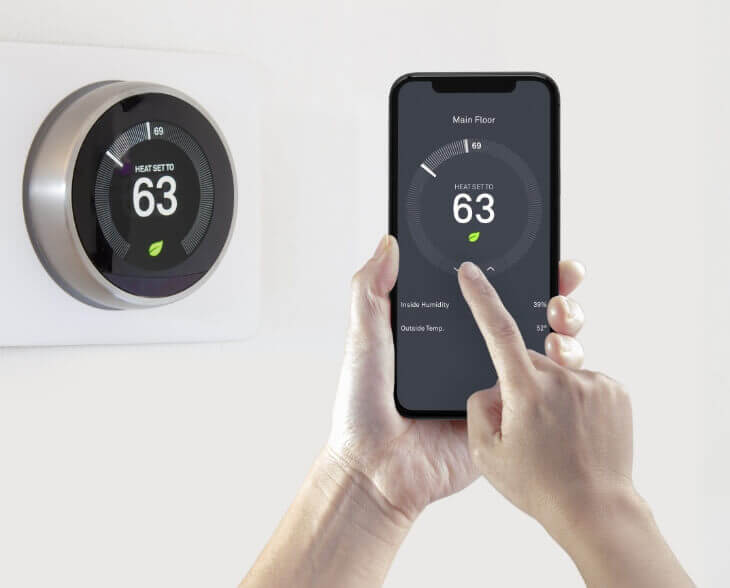
Nest, Ecobee, Honeywell and more — wired, mounted, and connected right. Learn more →→ Setup & Programming
Schedules, sensors, and app setup tuned to how your home actually runs. Learn more →→ Thermostat Repair
Wiring faults, compatibility issues, and replacements — diagnosed fast. Learn more →→
What thermostat work do you handle?
Installing and setting up smart, programmable and conventional thermostats, and figuring out why one has stopped driving the equipment. Any brand. We check compatibility against the system actually in your house first, then run a heating and a cooling cycle before leaving.
Can a smart thermostat be installed without a C-wire?
Yes, in most homes. The C-wire carries continuous power, and smart thermostats need it. Where one was never run, the fix is either an adapter at the furnace board, repurposing an unused conductor in the existing cable, or running new thermostat wire. All three are routine.
If your wall has no C-wire, we either add a power adapter at the furnace board or pull new thermostat cable. It is not a reason to give up on the thermostat you wanted.
Which smart thermostat works with my system?
The thermostat has to match the equipment, not the other way round. Single-stage gas heat takes almost anything. Heat pumps, multi-stage equipment and zoned systems narrow the list quickly, and line-voltage electric heat rules most smart thermostats out entirely.
What you can install is decided by your equipment and the wiring already at the wall, not by the feature list on the box.
Thermostat compatibility by system type.
| What you have | What it means | What can be installed |
|---|---|---|
| A C-wire already at the thermostat | Continuous power is available at the wall | Any mainstream smart thermostat |
| No C-wire, standard furnace | The thermostat has no steady power source | A smart thermostat, with a power adapter at the furnace board or new cable |
| Heat pump with auxiliary or emergency heat | The thermostat has to control the changeover and the backup heat | A heat pump capable smart thermostat, configured for the correct staging |
| Two-stage or variable-speed equipment | Extra conductors are needed to drive each stage | A multi-stage smart thermostat, wiring permitting |
| Millivolt or heat-only system | There is no 24-volt transformer to power a thermostat | A compatible millivolt thermostat, not a standard smart model |
| Line-voltage electric baseboard | The thermostat switches 120 or 240 volts directly | A line-voltage thermostat only |
| A zoned system with multiple thermostats | Each zone is driven through a zone control panel | Matched thermostats compatible with the existing panel |
Why is my thermostat not turning on the furnace?
The common causes are a dead battery, a tripped breaker, a blown low-voltage fuse on the furnace board, a loose or corroded wire at the terminal, or a furnace door switch that is not seated. Check the battery and the breaker first, since neither costs anything to rule out. If the heat still will not run, furnace and heating service takes it from there.
A visit without surprises.
Can a new thermostat lower my energy bills?
Some. The saving comes from schedules, setbacks and occupancy sensing rather than from the hardware itself, so it depends on how the house was being run before. A thermostat that is set and then ignored saves nothing, which is why the schedule gets built with you before we leave.
How do I book thermostat service?
Call (844) 584-7399 or schedule online. Most calls are handled the same day, and a thermostat that has stopped driving the heat counts as a no-heat call. We also check staging on heat pump service visits and during a full HVAC inspection.
What else do homeowners ask about thermostats?
Last updated
