

Keep your cool, Blue Ash
We repair and replace air conditioners, ductless systems included in Blue Ash, Ohio. Repairs, replacements and seasonal tune-ups, all priced before we start. Most calls get handled the same day, and someone answers the emergency line at any hour.
AC repair, replacement, and ductless systems for humid Ohio summers — fixed right the first time, at a price you approve before we start.
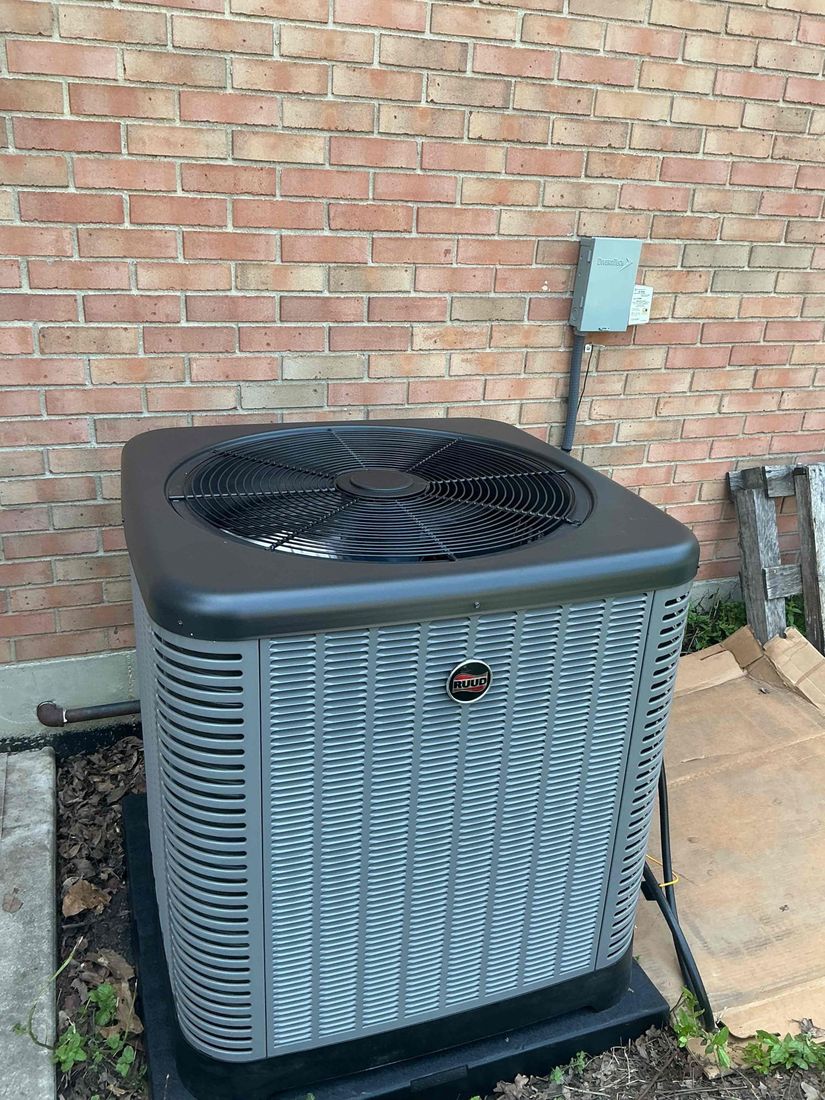
Every way a Blue Ash home stays cool.
Why is the house humid even when the AC is running?
Because cooling and dehumidifying are two different jobs and a system can do one without the other. Air conditioning pulls moisture out only while the coil is cold and air is moving across it for a sustained period. Short cycles from an oversized unit, a blower set too fast, or a thermostat set so the system barely runs will all leave you cool and damp. In a tighter newer house it can also be that there is simply more moisture indoors than the system was sized to remove, which is a dehumidification question rather than an air conditioning one.
There is water on the floor near the indoor unit.
Almost always the condensate drain. Cooling pulls moisture out of the air and that water has to go somewhere, usually down a small PVC line to a floor drain or a pump. Algae builds up in that line over a season and blocks it, the pan overflows, and you find it as a wet patch or a ceiling stain if the unit is upstairs. Many systems have a float switch that shuts the cooling off rather than let the pan overflow, so an air conditioner that has stopped for no obvious reason in humid weather is worth checking there first.
Is a bigger air conditioner better?
No, and this is the most expensive misunderstanding in the trade. An oversized unit cools the thermostat quickly, shuts off, and never runs long enough to pull moisture out of the air. The house hits the number and still feels clammy, which is the complaint that follows a great many new installations. Correct size comes from a heat gain calculation on your specific house: square footage, insulation, window area and orientation, ceiling height and duct condition. Matching the tonnage on the old label just repeats whatever mistake was made last time.
The outdoor unit is making a noise it did not make before.
The noise usually names the part. A hard electrical hum with the fan not turning points at a capacitor. A metallic screech on startup points at the compressor. A rattle that changes with fan speed is often a loose panel or debris in the cabinet, which is the one worth checking yourself with the power off. A hiss or a bubbling is refrigerant. What they have in common is that none of them improves on its own, and a capacitor caught early is a small repair while a compressor is a system decision.