

Plumbing has come to Hamilton County
We handle water heaters, drains, leaks and sewer lines in Hamilton County, Ohio. Our plumbers are licensed in Ohio, license #13557. Most calls get handled the same day, and someone answers the emergency line at any hour.
The same team you trust with your furnace now handles water heaters, drains, leaks, and sump pumps — with the same upfront pricing.
From the water heater to the sewer line.
A toilet that runs on and off by itself. Serious?
It is called phantom flushing and it means water is escaping from the tank into the bowl, so the fill valve keeps topping it up. The culprit is nearly always the flapper, which hardens with age and stops sealing, and it is one of the cheapest parts in the house. It is worth fixing quickly rather than living with, because it runs continuously and quietly, and a running toilet shows up on the water bill at a scale that surprises people who assumed it was just a noise.
Is a tankless water heater worth it?
It depends on the house more than on the technology. Tankless gives you hot water that does not run out and takes up far less room, and it lasts longer than a tank. Against that, it usually needs a larger gas line and different venting, so the install is a bigger job than a straight tank swap. It also wants descaling on a schedule in water as hard as ours, and skipping that is how people end up disappointed. If you are replacing in an emergency with no hot water in the house, a tank is usually the faster answer.
How long should a water heater last?
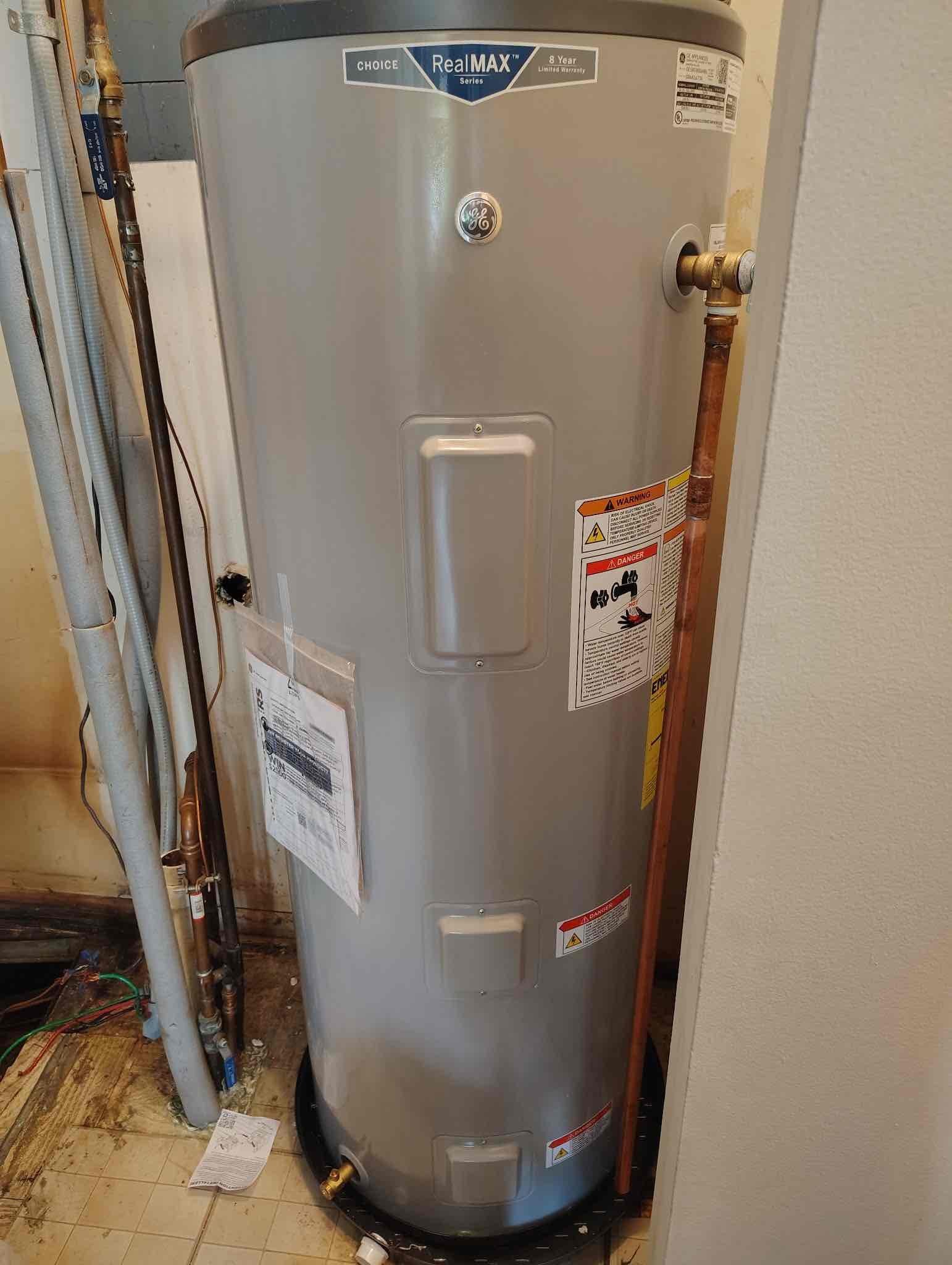
Eight to twelve years on a tank, longer on a tankless. What matters more than the number is how it fails: a heater at the end of its life usually goes by leaking from the tank itself, and a tank leak is not repairable. That is why it is worth knowing the age before it happens. The date is in the serial number on the label, and a photo of that label is a two-minute job that turns a future emergency into a planned replacement. If yours is in a finished basement or over living space, plan earlier rather than later.
Do you know where your main shutoff is?
It is the single most useful thing to know before you need it, and most people find out during the emergency. In this area it is usually where the line enters the basement or crawl space, often near the front of the house and close to the meter. Find it now, turn it to confirm it actually moves, and turn it back. A valve that has not been operated in twenty years can seize, and discovering that with water coming through a ceiling is a much worse time to learn it than a Saturday afternoon.