

Furnace repair and heating service in Huber Heights, Ohio
We repair and replace furnaces and heat pumps in Huber Heights, about twelve miles from the Beavercreek office, including the 10,707 single-family homes Huber Homes built here between 1956 and 1992. We answer the no-heat line at any hour.
Furnace repair, replacement, and heat pumps from techs who've worked every kind of Miami Valley home — with a 24/7 line for the January no-heat call.
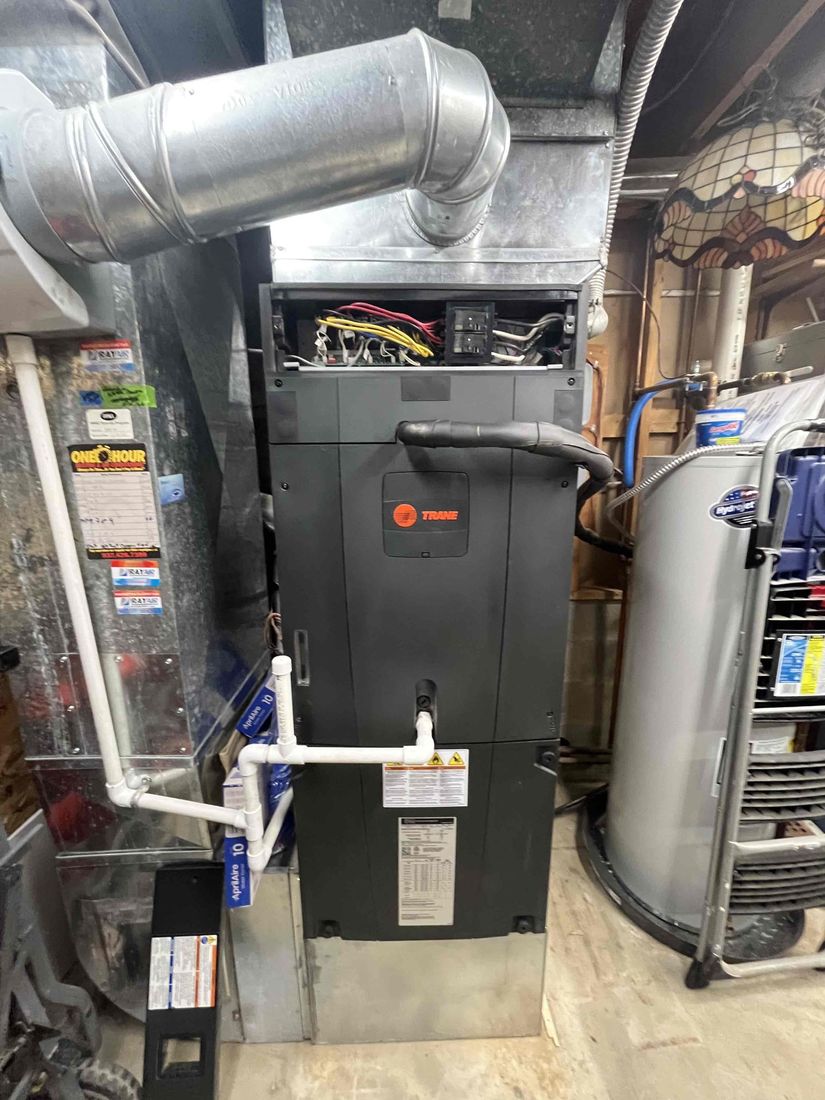
What heating work do you handle?
Any brand, any age, diagnosed and quoted before we start.
Why does a Huber Heights diagnosis go faster?
Because the houses repeat. Huber Homes built 10,707 single-family houses and 2,258 multi-family units here between 1956 and 1992, from a narrow set of plans, which means the same equipment locations, chase dimensions and duct layouts recur across thousands of addresses. A technician who has worked several hundred of them knows the layout before opening anything.
Why is the house so dry in winter, and does a humidifier help?
Cold outdoor air holds very little moisture, so every air change your house makes in January swaps damp indoor air for dry. The furnace does not cause it, it just moves it around. What you notice is static, dry skin, and gaps opening in hardwood floors and trim that close again in summer. A whole-house humidifier plumbed into the ductwork handles it more evenly than portable units, and it wants a humidistat rather than a fixed setting, because running too wet in a cold snap puts condensation on the inside of your windows.
Should the furnace and the air conditioner be replaced together?
Not automatically, but there is a real reason it comes up. The indoor coil sits in the furnace cabinet and the two are matched as a system, so replacing one and keeping the other can leave you with a pairing that does not hit the efficiency either part was rated for. If both are near end of life, doing them together costs less than two separate jobs because it is one visit and one set of connections. If the air conditioner is eight years old and healthy, keep it and say so to anyone who tells you otherwise.
What actually happens during a furnace tune-up?
It should be a list of measurements, not a look. Combustion analysis at the flue, gas pressure at the manifold, temperature rise across the heat exchanger, amp draw on the blower and the inducer, flame sensor cleaned and its microamp signal read, safeties tested rather than assumed, and a look at the heat exchanger itself. Ask for the numbers afterwards. A visit that produces no readings gives you nothing to compare against next year, and year-on-year comparison is most of what a tune-up is actually for.
Where should carbon monoxide alarms actually go?
One on every floor, and one within about fifteen feet of each sleeping area, because the whole point is waking someone up. They do not need to be at floor level; carbon monoxide mixes with air rather than sinking. Keep them a few feet clear of the furnace itself so brief startup readings do not nuisance-trip them. Replace the units on the date printed on the back, because the sensor has a service life whether or not it has ever sounded. If one goes off and then stops, treat it as real and get the furnace checked.
Should I repair my furnace or replace it?
How do I book heating service in Huber Heights?
Call (844) 584-7399 and you get a person, or book online in about a minute. If it's an emergency, no heat or water on the floor, call rather than booking. That skips the next-day queue and goes straight to the 24/7 line.