

Keep your cool, Miami County
We repair and replace air conditioners, ductless systems included in Miami County, Ohio. Repairs, replacements and seasonal tune-ups, all priced before we start. Most calls get handled the same day, and someone answers the emergency line at any hour.
AC repair, replacement, and ductless systems for humid Ohio summers — fixed right the first time, at a price you approve before we start.
Every way a Miami County home stays cool.
I am told the system needs refrigerant every year. Is that normal?
No. Refrigerant is not a consumable. It runs in a sealed loop and a correctly working system will hold the same charge for its whole life. A system that needs topping up annually has a leak, and adding refrigerant without finding it means paying every year for something escaping into the air. Ask for the leak to be found and quoted. Sometimes the answer is a repair worth making and sometimes it is a coil that costs enough to change the replacement conversation, but either way you should be told which.
There is water on the floor near the indoor unit.
Almost always the condensate drain. Cooling pulls moisture out of the air and that water has to go somewhere, usually down a small PVC line to a floor drain or a pump. Algae builds up in that line over a season and blocks it, the pan overflows, and you find it as a wet patch or a ceiling stain if the unit is upstairs. Many systems have a float switch that shuts the cooling off rather than let the pan overflow, so an air conditioner that has stopped for no obvious reason in humid weather is worth checking there first.
The air smells musty when the AC starts.
That smell is biological growth on a coil that stays wet, and it is common in systems that short cycle or run with the fan permanently on. It is worth taking seriously rather than masking, because the air carrying it is the air the whole house breathes. The fixes go in order of cost: clear and treat the condensate drain, clean the coil properly rather than spraying it, correct whatever is keeping the coil wet, and only then look at UV or filtration. Starting at the last step is how people spend money and still smell it.
The outdoor unit is making a noise it did not make before.
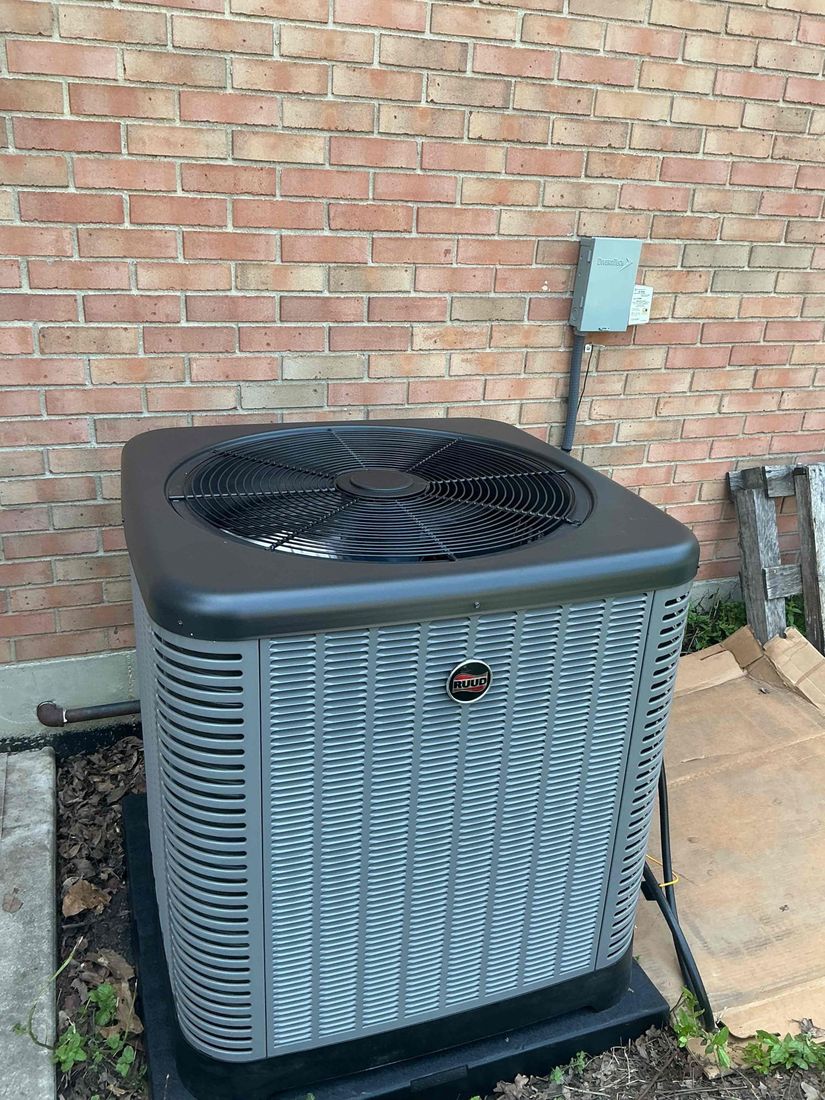
The noise usually names the part. A hard electrical hum with the fan not turning points at a capacitor. A metallic screech on startup points at the compressor. A rattle that changes with fan speed is often a loose panel or debris in the cabinet, which is the one worth checking yourself with the power off. A hiss or a bubbling is refrigerant. What they have in common is that none of them improves on its own, and a capacitor caught early is a small repair while a compressor is a system decision.