

Cleaner ducts, cleaner air in Clark County
We clean supply ducts, returns, blower compartments and dryer vents in Clark County, Ohio. A camera goes into your ductwork before we quote anything. Most calls get handled the same day, and someone answers the emergency line at any hour.
Whole-home duct cleaning with negative-pressure equipment — and before/after photos so you can see exactly what you paid for.
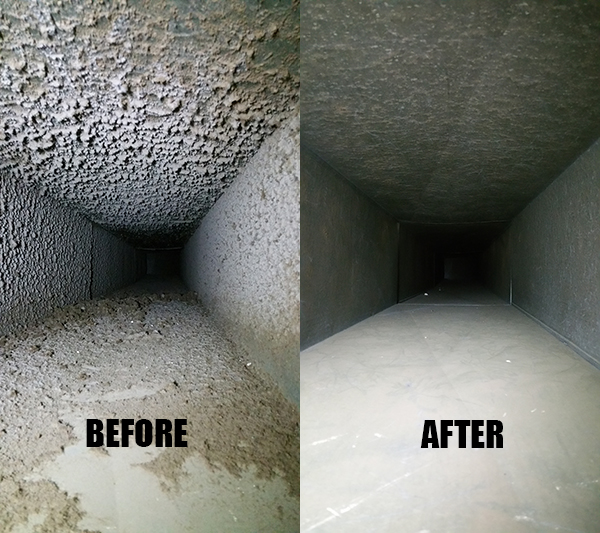
The whole system — not just the vents you can see.
What does a proper duct cleaning actually involve?
Negative pressure and agitation, in that order. A vacuum unit is connected to the system so the whole duct run is under suction, and then each branch is agitated with brushes or air whips so what is stuck to the wall lets go and gets pulled out rather than blown further in. The furnace or air handler cabinet, the blower wheel and the coil are part of the job, because a clean duct feeding a filthy blower has not achieved much. Anything advertised as a quick vacuum at each register is not this.
Is duct sealing different from duct cleaning?
Completely, and sealing is usually the one that saves money. Cleaning removes what is inside the ducts. Sealing closes the joints and seams that are leaking conditioned air into an attic, a crawl space or a wall cavity, which in a typical house is a meaningful share of what you paid to heat and cool. If your goal is a lower bill or rooms that never keep up, sealing and airflow are the conversation. If your goal is what is coming out of the registers, cleaning is.
How often should ducts be cleaned?
There is no calendar answer, and any company giving you a fixed interval is guessing at your house. Condition drives it: pets, smokers, allergies, recent construction, and whether the system has been run without a filter all change the answer far more than time does. For most houses with none of those, the honest interval is longer than the industry advertises. Look inside a register every couple of years and let what you see decide it.
Is the dryer vent worth doing at the same time?
It is the one in this category with a genuine safety case, and it is often the more urgent of the two. Lint accumulates in the duct run rather than in the trap, and a restricted dryer vent is both a fire risk and the reason a load takes three cycles to dry. The signs are clothes still damp on a normal cycle, the outside of the dryer running hot, or a flap outside that no longer opens properly. Long runs and runs with several elbows need it more often than short straight ones.