

Cleaner ducts, cleaner air in Lebanon
We clean supply ducts, returns, blower compartments and dryer vents in Lebanon, Ohio. A camera goes into your ductwork before we quote anything. Most calls get handled the same day, and someone answers the emergency line at any hour.
Whole-home duct cleaning with negative-pressure equipment — and before/after photos so you can see exactly what you paid for.
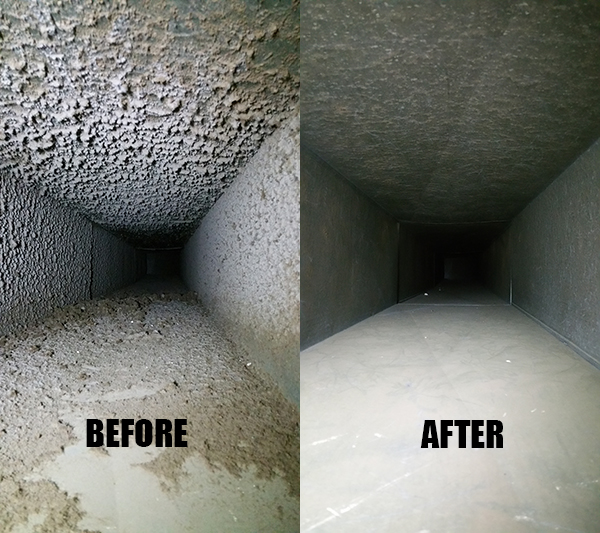
The whole system — not just the vents you can see.
Will cleaning improve my airflow?
Only if the restriction is actually dust, which it usually is not. Weak airflow is far more often undersized returns, crushed flex duct, closed dampers, a dirty blower wheel or a filter too dense for the system. A blower wheel caked with dust genuinely does move less air and does get better after cleaning. Duct walls with a dusting on them do not restrict much. If airflow is the complaint, ask for static pressure to be measured, because that number tells you where the restriction really is.
There is something that looks like mold in the ductwork.
Stop and identify it before anyone cleans it. Growth in ductwork means moisture is getting in, and cleaning without fixing the moisture buys you a few months. The usual sources are an air conditioner coil that never dries out, a condensate problem, uninsulated metal duct sweating in a humid crawl space, or duct board that got wet. Cleaning is part of the answer, but the part that matters is finding out where the water is coming from, and that is a different conversation from a cleaning quote.
Should I have the ducts sanitized or fogged?
Be careful with this one. Spraying a biocide or a sealant into ductwork is sold as an add-on far more often than it is genuinely warranted, and you are putting a chemical into the path that feeds every room in your house. If there is confirmed growth, the answer is finding the moisture and removing the growth mechanically. Ask what specifically is being applied, why it is needed in your case, and what the label says about occupied spaces. A vague answer to any of those is your answer.
Is the dryer vent worth doing at the same time?
It is the one in this category with a genuine safety case, and it is often the more urgent of the two. Lint accumulates in the duct run rather than in the trap, and a restricted dryer vent is both a fire risk and the reason a load takes three cycles to dry. The signs are clothes still damp on a normal cycle, the outside of the dryer running hot, or a flap outside that no longer opens properly. Long runs and runs with several elbows need it more often than short straight ones.